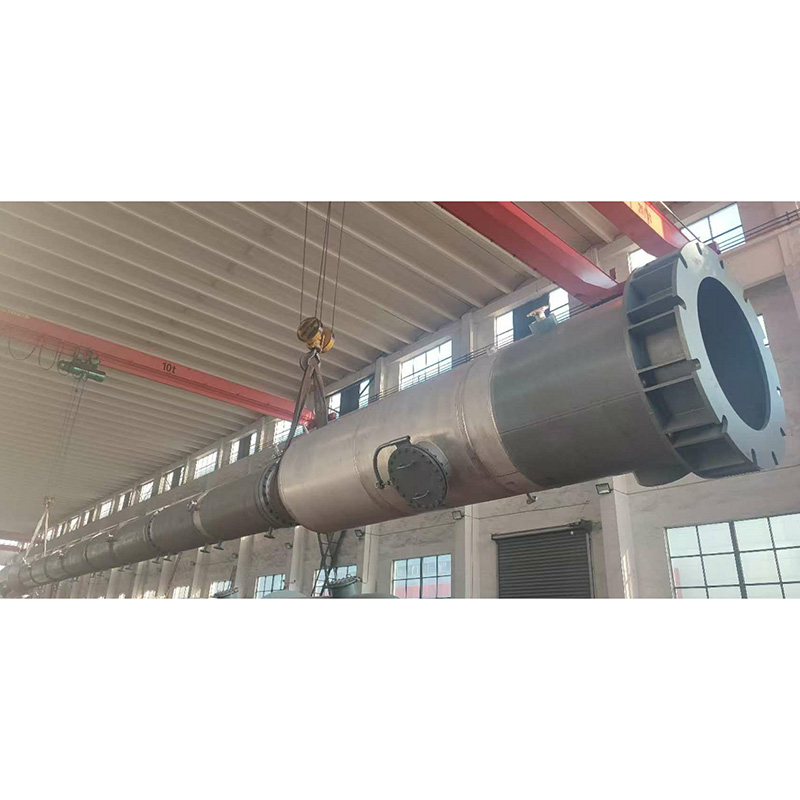
Chemical Industry Methanol Acetone Organic Solvent Recovery Distillation Column
Wiki Article
High separation efficiency Acetone Distillation Tower is a commonly Distillation tower equipment, and Wuxi Hongdinghua Chemical Equipment Co., Ltd. (HDH) has years of experience in designing and manufacturing Acetone Distillation Towers.
Acetone is an important organic synthetic raw material used in the production of epoxy resins, polycarbonates, organic glass, pharmaceuticals, pesticides, etc. It is also a good solvent for coatings, adhesives etc. It is also used as a diluent, cleaning agent, and extractant. It is also an important raw material for manufacturing acetic anhydride, diacetone alcohol, chloroform, iodoform, epoxy resin, polyisoprene rubber, etc. Used as a solvent in industries such as smokeless gunpowder, celluloid, acetate fiber, and spray paint, as well as as as an extraction agent in industries such as grease.
So it is very important to concentrate and recycle acetone, Wuxi Hongdinghua Chemical Equipment Co., Ltd. has rich experience in recovering acetone from acetone solutions under various conditions. The Acetone Distillation Tower designed and manufactured by HDH has a wide range of applications in various industries.
Wuxi Hongdinghua Chemical Equipment has regular demand of designing and manufacturing Acetone Distillation Towers from customers for many years. Acetone distillation towers are widely accepted by customers in industries such as chemical, pharmaceutical, and environmental protection. Acetone distillation tower is widely used as an equipment of gas-liquid mass transfer equipment in production. According to the form of gas-liquid contact components inside the tower, it can be divided into Packing type Acetone Distillation Tower and Plate type Acetone Distillation Tower. The plate type acetone distillation tower belongs to stepwise contact countercurrent operation, while the Packing type acetone distillation tower belongs to differential contact operation.
The main requirements for acetone distillation tower equipment in industry
The reasonable selection of acetone distillation tower type is the primary step in the design of Acetone Distillation Tower. When selecting, the following should be considered
1. Specifications of Materials
2. Acetone Distillation Tower’s operating conditions
3. Performance of Acetone Distillation Tower
4. Factors related to the manufacturing, installation, operation, and maintenance of Acetone Distillation Tower.
The basic performance indicators of acetone distillation tower mainly include
1. Yield and flux: Yield refers to the amount of material processed per unit time, while flux refers to the amount of material processed per unit time on a unit tower cross-section.
2. Separation efficiency: For a plate tower, it refers to the degree of separation that each layer of tray can achieve. The packing tower is the separation capacity per unit height of the packing layer.
3. Adaptability and operational flexibility: The ability to adapt to various material properties and maintain stable operation and high separation efficiency during load fluctuations.
4. Fluid resistance: The pressure drop of the gas phase through each layer of tray or unit height packing layer.
Wuxi Hongdinghua fully considers the following factors for customers in designing and manufacturing acetone distillation towers
Cost of Acetone Distillation Tower
2. The difficulty of installation and maintenance
3. Factors such as long-term operational reliability
Provide parameters and technical data
HDH will ask your to provide following technical data, parameters and material specifications when HDH is doing designing and manufacturing for you as following:
(1) Raw Material Feeding amount per unit time: _____
(2) Detailed composition of raw materials: _____
(3) Tower top output amount _____kg/h, with a concentration requirement of _____%;
(4) Tower bottom output amount _____kg/h, with a concentration requirement of _____%;
(5) Whether the material has thermal sensitivity: □; Please specify: _____
(6) Corrosion: _____ ;
(7) Operating flexibility: _____upper limit; _____Lower limit;
(8) Operating time: _____hours/day;
(9) Cooling water temperature (inlet/outlet): _____℃ in summer, _____℃ in winter;
(10) Chilled water temperature (inlet/outlet): _____ ℃;
(11) Steam pressure (gauge pressure): _____MPa
(12) Heat transfer oil temperature: _____℃;
(13) Installation environment: indoor □;outdoor □
(14) Meteorological environmental conditions
(15) Selection conditions for electrical equipment (Electric Power Supply Condition) _____